
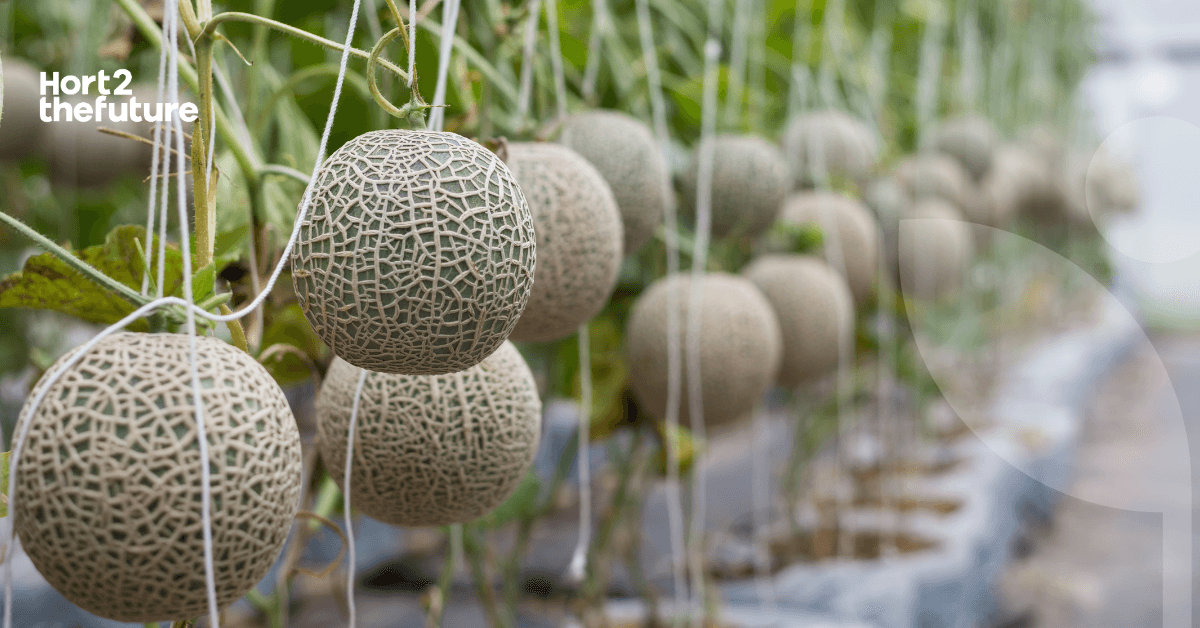
Within the Hort2theFuture project, Saad Khahli, a master’s student at the Technical University of Cartagena (UPCT), and with the technical support from the JUAN AZCUE company, investigated the use of oxygen microbubbles in irrigation water to counteract the negative effects of soil compaction in melon crops. Oxygen microbubbles are extremely small bubbles that enrich irrigation water with dissolved oxygen, providing benefits for both soil and plant health.
What is soil compaction and why does it matter?
Soil compaction is one of the most common challenges in intensive agriculture. It occurs when soil becomes denser, restricting root growth and reducing the movement of air and water. These constraints can significantly limit crop performance. In the Campo de Cartagena region (Murcia, Spain), a major horticultural production area, heavy machinery traffic and low organic matter content increase the risk of soil compaction.
To assess the potential of oxygen microbubble irrigation, six treatments were tested, combining three soil compaction levels (no compaction, intermediate, and high) with and without oxygenated irrigation. The trial was conducted at the CDTA *El Mirador* experimental station in San Javier (Murcia), using a microbubble generator that enriched irrigation water with up to 20 mg/L of dissolved oxygen.
The effects of oxygenation on soil health and crop yield
The results showed clear improvements in plant physiology when oxygen microbubbles were applied:
- Photosynthesis increased significantly under oxygenated irrigation across all compaction levels
- Internal CO₂ concentrations decreased, indicating more efficient leaf metabolism
- In compacted soils, melons reached maturity earlier, enabling earlier harvests
While yield increases were observed only in non-compacted soils, these physiological responses suggest that microbubbles help plants better cope with challenging soil conditions.
Oxygen microbubble irrigation also had a strong positive effect on soil biological activity:
- Soil respiration increased at all compaction levels
- Enzyme activities linked to microbial metabolism and nutrient cycling, particularly nitrogen and carbon, were improved
- Soil bulk density decreased, especially in moderately compacted soils, indicating improvements in soil structure and aggregation driven by enhanced root activity
These results show that soil oxygenation can activate microbial communities, improve nutrient availability, and partially alleviate structural constraints caused by compaction.
How are soil and plants connected?
A multivariate analysis showed a strong relationship between soil oxygenation, microbial activity, and plant photosynthetic performance. Treatments using microbubble irrigation were clearly distinct from conventional irrigation, highlighting coordinated improvements in both soil biochemical indicators and plant physiology.
This research demonstrates that oxygen microbubble irrigation is a promising tool for improving soil health and supporting plant performance, even under challenging conditions. While yield responses depend on soil structure, environmental conditions, and crop type, the technology offers an attractive strategy for horticultural systems affected by soil compaction and poor aeration.
What about the future?
Within Hort2theFuture, future trials will explore the effects of microbubbles on winter crops such as broccoli and kohlrabi, which have different root systems and varying susceptibility to soil compaction. In addition, nanobubble technology developed by NOVAGRIC will be integrated into the experiments and compared with microbubbles to assess whether bubble size and oxygen retention in soil pores provide additional benefits.